
How to Choose the Right Blender Glass Jar Manufacturer in China
Quick Answer
Choosing the right blender glass jar manufacturer in China means looking beyond price. Buyers should evaluate product quality, food-grade materials, manufacturing experience, OEM and ODM capability, quality control, production capacity, compatibility support, and export experience. A reliable supplier should offer stable quality, customization options, and long-term wholesale supply for importers, distributors, appliance brands, and replacement parts buyers.
Why It Matters
China is a major production base for blender glass jars and replacement blender parts, but supplier quality can vary widely. The right manufacturing partner helps reduce defects, improve customer satisfaction, support private label projects, and keep supply chains stable. For wholesalers and appliance brands, this is a long-term business decision, not just a purchasing choice.
Food-contact materials matter especially in this category. Food-safe glass materials such as soda-lime glass are widely used for food-contact containers because they provide good transparency, durability, and practical cost efficiency.
What to Check
1. Manufacturing Experience
A factory that focuses on blender glass jars usually understands structure, compatibility, packaging, and export requirements better than a general glass supplier. Ask how long they have produced blender jars, whether they specialize in replacement parts, and which markets they serve.
2. Product Quality
The best blender glass jar supplier should use food-grade soda lime glass and maintain consistent quality. Key signs of good quality include smooth surface finish, stable thickness, strong impact resistance, and accurate dimensions. Better quality means fewer returns and better customer trust.
3. Thermal Shock Testing
Blender jars often face cold ingredients, warm liquids, and repeated cleaning. That is why thermal shock resistance matters. A qualified OEM blender jar manufacturer should test products under hot and cold conditions before shipment to reduce cracking risk. Reliable testing and inspection are essential for consistent product performance.
In industrial glass testing systems (ASTM/ISO-based methods), ΔT 40–60°C is commonly applied as a standard thermal shock qualification threshold for food-grade glass containers.
4. OEM and ODM Support
If you need branded or customized products, look for a factory that offers logo printing, custom packaging, capacity customization, mold development, product design support, and private label production. OEM and ODM services help brands build identity and improve competitiveness.
5. Quality Control
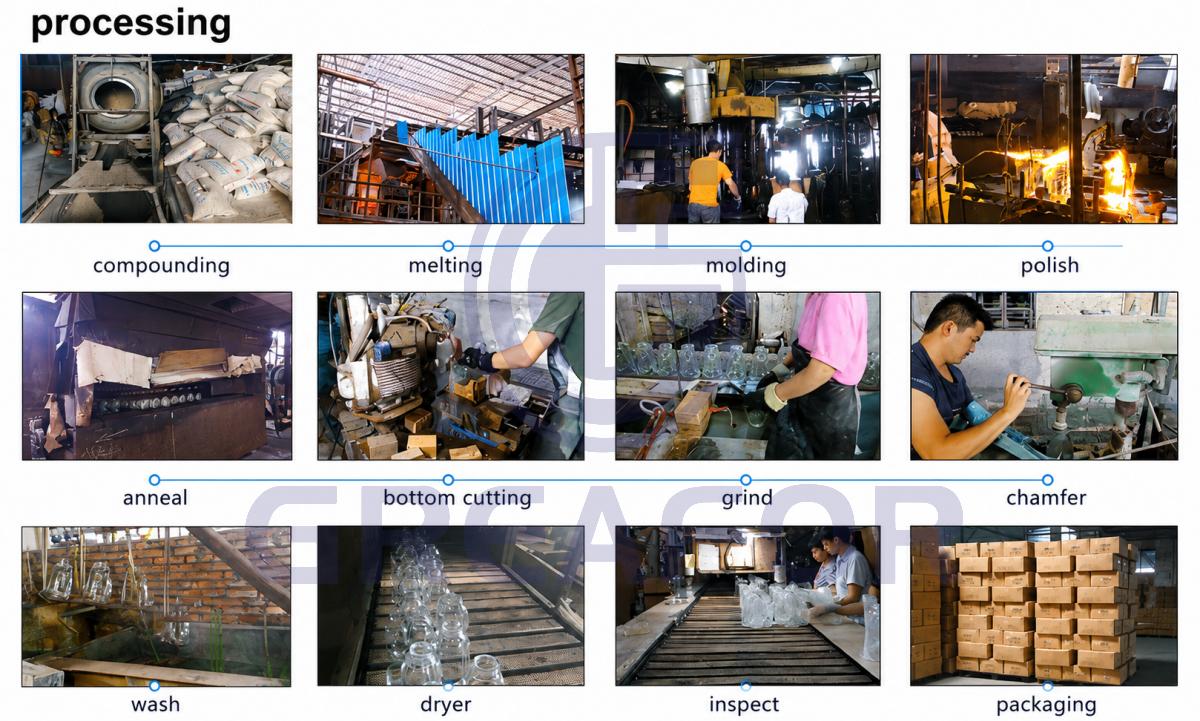
A reliable factory should inspect products at every stage: raw material inspection, in-process inspection, dimensional checking, thermal shock testing, final visual inspection, and packaging inspection. Strong quality control is one of the clearest signs of a dependable manufacturer.
6. Production Capacity
Production capacity affects lead time and supply stability. Ask whether the supplier can handle bulk orders, repeat orders, and peak-season demand. A manufacturer with strong capacity is better suited for wholesale buyers and long-term supply projects.
7. Export Experience
Export experience matters because overseas buyers need clear communication, proper packaging, shipping readiness, and customs understanding. A supplier with international experience is usually more reliable for importers and distributors.
8. Compatibility Expertise
Many buyers need compatible replacement blender jars rather than only new product development. In that case, the supplier should understand thread size, base fit, blade assembly matching, and lid compatibility. This is especially important in the aftermarket and replacement parts market.
This ensures consistent performance under thermal stress conditions typically encountered in kitchen appliance applications, including sudden transitions from refrigerated ingredients to mechanical blending operations.
Refer to Greafor's Model Compatibility Lists.
9. Sample Availability
Always request samples before bulk orders. Samples let you check glass clarity, dimensions, finish, packaging quality, and durability. A professional supplier should be willing to provide samples for evaluation.
10. Long-Term Partnership
The lowest price is not always the best choice. A better supplier offers stable quality, clear communication, on-time delivery, and ongoing product support. For wholesalers and brands, long-term cooperation usually creates more value than short-term savings.
Quick Checklist
| Evaluation Item | Key Questions to Ask |
|---|---|
| Material | Is the glass thick enough and suitable for daily use? |
| Thermal Shock Resistance | Has the jar been tested for sudden temperature changes? |
| Compatibility | Does it fit the target blender model or part number? |
| OEM / ODM | Can the supplier support custom molds, logos, and packaging? |
| Quality Control | What inspection process is used before shipment? |
| MOQ | What is the minimum order quantity per SKU? |
| Lead Time | How long does production take after order confirmation? |
| Sampling | Can samples be provided before mass production? |
| Packaging | Can packaging be customized for wholesale or retail? |
| Commercial Terms | What are the payment and shipping terms? |
Frequently Asked Questions
What material is best for blender glass jars?
Food-grade soda lime glass is widely used because it offers good transparency, durability, and cost efficiency.
Why is thermal shock resistance important?
It helps prevent cracking when the glass is exposed to sudden temperature changes.
What is an OEM blender jar?
An OEM blender jar is made according to the buyer’s branding and product specifications.
Can a manufacturer provide private label services?
Yes. Many manufacturers offer logo printing, custom packaging, and private label production.
How do I evaluate a blender jar supplier?
Check manufacturing experience, quality control, testing procedures, production capacity, and OEM capabilities.
What is the industry standard for blender glass jar thermal shock resistance?
Industry standard thermal shock resistance for blender glass jars is typically evaluated using temperature differential testing (ΔT). In OEM manufacturing, soda-lime glass jars commonly pass a thermal shock range of 40°C to 60°C, which is widely used as a mass-production quality control threshold. Higher-grade borosilicate glass can exceed 120°C depending on material composition and wall thickness. This testing simulates real-world transitions such as moving from refrigeration conditions to high-speed blending environments.
How do Chinese factories handle OEM/ODM molds for blender jars?
Chinese OEM/ODM factories typically manage blender jar mold development through structured engineering workflows including 3D design, precision tooling, sample prototyping, and dimensional validation. For OEM projects, molds are developed based on client drawings or physical samples to ensure precise compatibility with blade assemblies, base couplings, and sealing systems. Key tolerances are generally controlled within ±0.2 mm to ensure consistent fit across mass production batches. ODM projects include in-house design, testing, and functional validation before production approval.
Conclusion
Choosing the right blender glass jar manufacturer in China is about more than price. Buyers should focus on material quality, testing standards, OEM support, production capacity, compatibility support, and export experience. A dependable blender jar supplier can help you maintain product consistency, strengthen your brand, and build a stable business in wholesale and replacement parts markets.
About Greafor
Greafor specializes in the manufacturing of blender glass jars, replacement blender parts, and OEM blender solutions. With experience in glass processing, quality control, and customization, Greafor supports distributors, importers, wholesalers, and appliance brands worldwide with reliable manufacturing solutions.
Get a quote via WhatsApp