

Related Projects
OEM Blender Parts: What Can a Chinese Manufacturer Customize for Bulk Orders?
A request for “custom blender parts” can mean very different things in global B2B procurement.
One distributor may want an existing glass jar packed in a branded retail box. Another may need a modified jar height while maintaining compatibility with their current blade connection. A growing appliance brand may be developing an entirely new jar, lid, and stainless steel blade assembly from scratch.
These distinct projects require completely different quotation structures, sample stages, and tooling investments. Before reaching out to a manufacturing partner for an OEM/ODM quote, it helps to clearly separate what needs to change from what already works.
With manufacturing roots in kitchen-appliance glass production dating back to 2012, Greafor (the export brand of Foshan Huijing Glass Products Co., Ltd.) has spent over 14 years supporting global importers, wholesalers, aftermarket parts distributors, and appliance brands. For bulk buyers sourcing blender glass jars, meat chopper bowls, and related replacement components, the most critical question isn't simply “Can this part be customized?”—it is “Which modifications truly add market value, and how do they impact the rest of the assembly?”
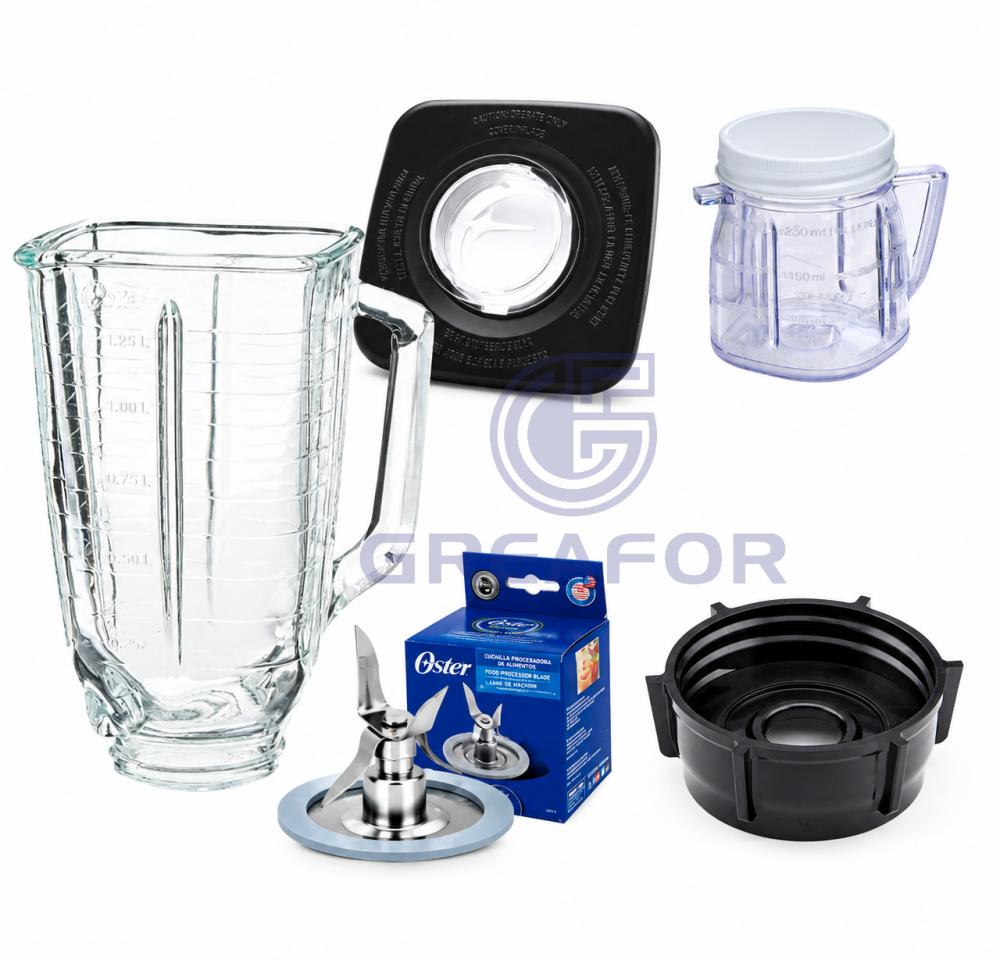
1. Start by Defining What Should Stay the Same
Buyers often focus entirely on the feature they want to alter: a larger capacity, a vibrant lid color, or a custom ceramic-printed logo. However, defining the constants is equally vital to avoid unnecessary tooling costs and engineering delays.
-
Retaining Existing Interfaces: If your distribution network already relies on a specific blade assembly or jar base, any new jar design must preserve that exact bottom connection and thread type.
-
Brand Consistency Across SKUs: If you are rolling out a multi-tiered product line, you can standardize the packaging artwork while allowing each model to maintain its unique technical specification.
Sample Brief Structure for Efficient Communication:
Option A (Private Label / Surface Customization): “Keep the existing standard jar and blade configuration. Add our private-label logo, custom-printed retail product boxes, and localized barcode labels for each SKU.”
Option B (Structural OEM Development): “Develop a revised glass jar profile for our new blender model. The lid fit and blade assembly must be re-engineered and reviewed alongside this new design.”
Clear upfront parameters save weeks of back-and-forth communication and protect your project budget from redundant development fees.
2. Glass Blender Jars: Which Features Can Be Customized?
Customizing a soda-lime glass blender jar involves more than just changing mold dimensions. Feasibility depends closely on thermal shock requirements, structural integrity, and manufacturing parameters.
Capacity, Shape, and Dimensions
Importers often request a unique capacity or profile to differentiate their product from generic market offerings.
-
The Engineering Reality: Capacity alone is not a sufficient design brief. Procurement teams must also specify target heights, maximum outer diameters, handle ergonomics, and the clearance space inside the blender housing.
-
Best Practice: Providing technical drawings, CAD files, or physical reference samples yields much faster and more accurate feedback than descriptive phrases like "a slightly bigger version of this jar."
Bottom Structure and Component Interfaces
The bottom connection is the heart of the appliance and requires meticulous engineering:
-
Modifications to the bottom structure, threading, or sealing groove directly dictate the choice of blade assemblies, sealing gaskets, and retaining rings.
-
For established aftermarket replacement-parts suppliers, retaining familiar interface dimensions is usually the safest commercial choice. For brand-new appliance developments, co-designing the entire interface ensures optimal performance.
Glass Color, Logo, and Branding
Enhancing brand recognition on glassware requires careful planning:
-
Branding vs. Coloring: Changing the bulk glass tint is a raw-material melt process, whereas adding high-temperature fired logos or measurement graduations is a post-processing step. These represent entirely different production workflows and cost tiers.
-
Unified Review: Always submit your vector artwork and specify the exact placement for both your brand logo and volume graduations simultaneously to streamline batch approvals.
3. Blade Assemblies: Define More Than Blade Shape
For OEM blender blade projects, a simple photograph is rarely enough to lock down production specifications. A complete technical evaluation requires looking at the holistic assembly.
When submitting a request, clarify whether your project involves:
-
Blade Geometry & Material: Specialized cutting angles and stainless steel grade specifications.
-
Shaft & Bearing Dimensions: Precision tolerances for smooth, leak-free rotation.
-
Sealing Systems: Gasket material (silicone vs. rubber) tailored to food-safety and temperature standards.
-
System Matching: Whether the assembly is engineered to pair with a proprietary new jar or an existing market standard.
Greafor evaluates custom blade and assembly requirements on a project-by-project basis to ensure complete component harmony.
4. Lids and Couplings: Separate Appearance from Fit
While a lid color change and a structural lid redesign may look identical on a simple purchasing checklist, they involve completely different engineering steps:
-
Color / Logo Updates: Focused purely on master batch coloring and surface printing options.
-
Structural / Fit Redesign: Requires reviewing the jar opening rim dimensions, inner lips, and venting mechanisms to guarantee a secure, user-friendly seal.
-
Couplings: Because couplings transfer mechanical torque directly from the motor base to the blades, dimensional accuracy and material durability take absolute priority over visual appearance. Always supply original reference samples or mating specifications.
5. Packaging & Private-Label Programs Without Component Redesign
Not every brand expansion requires reinventing the glass jar. If an existing jar, lid, and blade set already satisfies your market demands, launching a private-label packaging program is the fastest route to market.
A comprehensive bulk packaging brief typically outlines:
-
Custom product boxes featuring brand typography and high-impact graphics.
-
Tailored SKU labeling, regional barcodes, and multi-language instruction manuals.
-
Master carton specifications, drop-test requirements, and palletization layouts.
-
Unit-set configurations (e.g., specifying whether a box contains a standalone jar or a complete jar-and-blade kit).
For a deeper dive into scaling your brand footprint, explore our dedicated guide on How to Build a Private Label Blender Accessories Program.
6. Meat Chopper Glass Bowls Follow the Same Principles
Beyond blender components, Greafor regularly partners with global brands on custom OEM projects for meat chopper glass bowls and associated drive interfaces.
Just like blender jars, these projects require a clear distinction between aesthetic changes (such as bowl wall thickness, capacity tiers, or exterior texturing) and functional parameters (such as the central rotor shaft interface and lid-locking rim dimensions). Sourcing both product lines concurrently can significantly streamline logistics and container consolidation for large-scale distributors.
7. How to Structure an Effective Bulk Customization Inquiry
An actionable OEM inquiry doesn't need to be a 50-page engineering thesis, but it must give the manufacturer a structured starting point. Use the following framework when preparing your request:
| Parameter | What to Specify |
| Starting Reference | Existing model number, technical drawing, high-resolution photo, or physical sample |
| Requested Changes | Target capacity, dimensional shifts, material grade, interface adjustments, or custom packaging |
| Features to Retain | Fixed jar connections, established blade assemblies, or standardized lid-fit tolerances |
| Supply Scope | Standalone individual components versus fully coordinated multi-part box sets |
| Order Volume | Estimated pieces per SKU and projected annual replenishment demand |
| Destination Market | Target country, compliance language requirements, and distribution channels |
| Timeline | Required prototype sampling windows and target mass-production delivery dates |
For detailed insights regarding batch thresholds, read our guide on What MOQ Should You Expect from a Blender Jar Factory?
Discuss Your OEM Blender Parts Project with Greafor
Successful manufacturing partnerships begin with clear commercial alignment. Whether you are scaling an aftermarket replacement catalog, building a private-label accessories range, or developing an innovative new blender system, Greafor brings 14+ years of dedicated glass-manufacturing expertise to your supply chain.
Get in touch with our engineering and export team today by providing:
-
Your company profile and target destination market.
-
The specific product categories or model types you wish to source.
-
Available technical drawings, reference photos, or sample details.
-
A clear breakdown of required modifications versus features that must remain unchanged.
-
Estimated initial quantities and anticipated replenishment schedules.
Explore Greafor OEM/ODM Services and submit your project brief today for a comprehensive, product-specific wholesale evaluation.