

Related Projects
OEM vs Compatible Replacement Blender Parts: Which Solution Is Better for Distributors?
When you are building a blender parts business, the sourcing question is rarely just “Which supplier has the lowest price?” More often, it is whether you should invest in OEM blender parts, wholesale compatible replacement parts, or use a combination of both.
OEM parts give you more control over your product, brand, and packaging. Compatible parts are usually faster to source and can help you build a broader replacement-parts catalog with less upfront investment.
Neither option is automatically better. The right choice depends on the customers you serve, the budget you can commit, how quickly you need to enter the market, and whether you want to build a long-term private-label brand.
For many distributors, the practical answer is not OEM or compatible parts. It is a phased strategy that starts with compatible products and adds OEM or private-label items once demand is proven.
The Short Answer
Choose OEM blender parts if you want to build a distinctive product line, control the specification, and sell under your own brand.
Choose compatible blender replacement parts if you need standard products quickly, want to keep initial investment lower, or serve repair and aftermarket customers.
If you are still testing the market, compatible parts are often the safer starting point. If you already have stable sales and a clear brand plan, OEM development can give you better control and stronger long-term positioning.
OEM vs Compatible Blender Parts at a Glance
| Factor | OEM Blender Parts | Compatible Replacement Blender Parts |
|---|---|---|
| Cost | Higher upfront cost if new tooling, custom components, or dedicated packaging are required | Usually lower initial investment when an existing compatible model is available |
| MOQ | Often higher for custom colors, packaging, structures, or new molds | Often more flexible for standard parts, subject to stock and production planning |
| Customization | High: specifications, materials, color, logo, packaging, and component combinations | Usually limited to packaging, labels, selected colors, and existing configurations |
| Market Entry | Takes longer because samples, specifications, and production details need to be confirmed | Faster, as the product may already be available for sampling and quotation |
| Risk | More investment at the start, but greater control and potential for differentiation | Lower development risk, but more competition in common replacement categories |
| Best Fit | Brand owners, private-label programs, and distributors with steady volume | Repair suppliers, wholesalers, importers, and buyers building a broad aftermarket catalog |
What Are OEM Blender Parts?
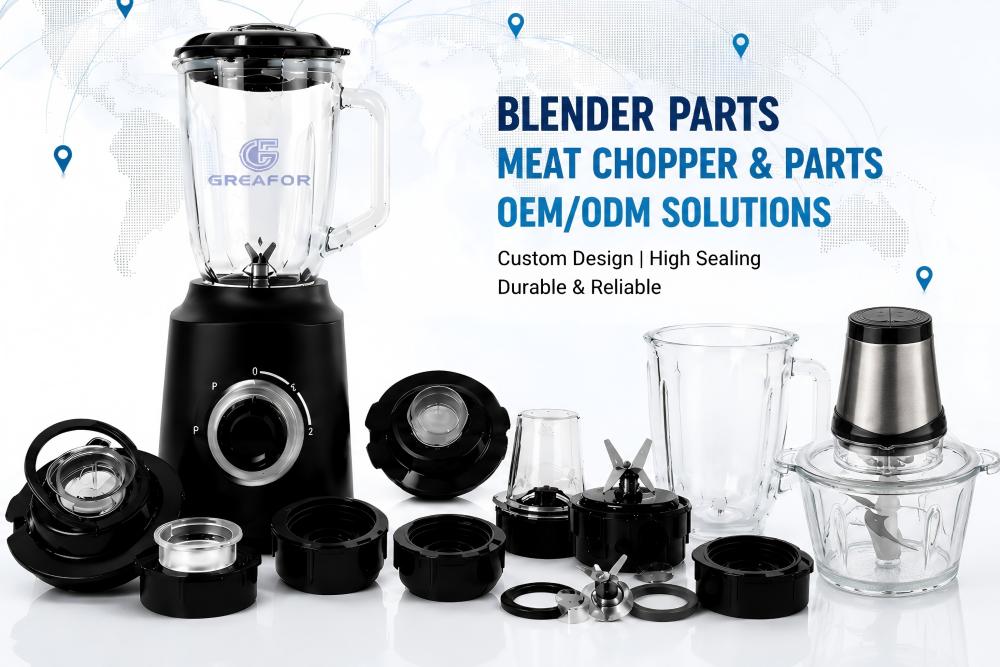
OEM blender parts are made around a buyer’s product requirements. The project may involve an existing design with custom branding, or it may require a new jar shape, blade assembly, coupling, lid, material, or packaging concept.
An OEM blender parts supplier can usually support projects such as:
-
Custom glass blender jars and blender jugs
-
Blender blade assemblies
-
Blender couplings and drive couplings
-
Jar bases, lids, handles, caps, and sealing rings
-
Product colors, logos, and private-label packaging
-
Coordinated parts sets for a new or existing blender line
The main advantage is control. You can decide how the product looks, how it is packaged, which accessories are included, and how it fits into your overall brand range.
The trade-off is that OEM projects need more preparation. You may need technical drawings, samples, packaging artwork, target quantities, and time for approval before production can begin.
What Are Compatible Replacement Blender Parts?
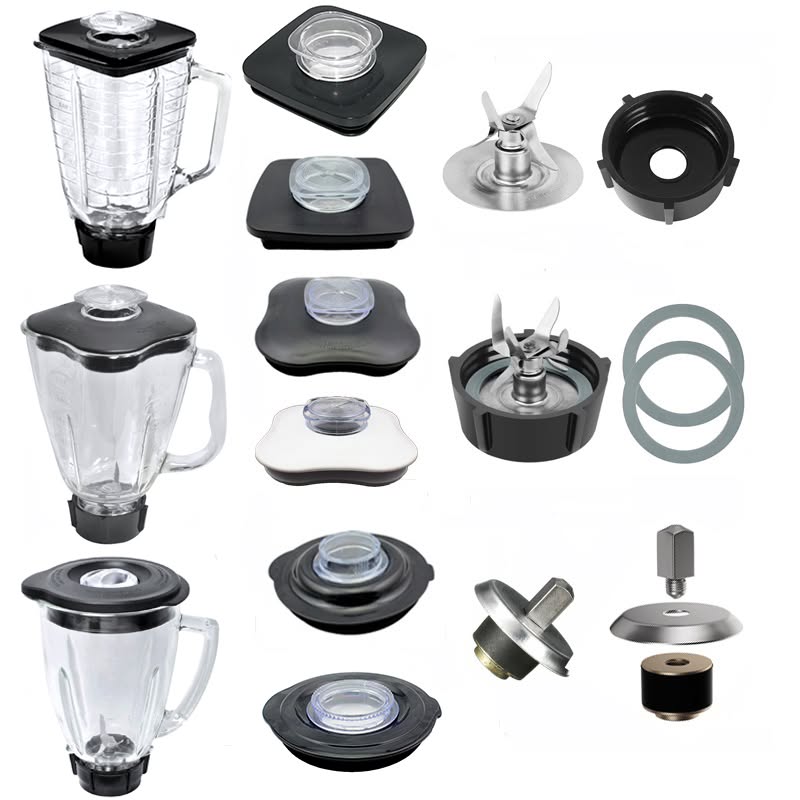
Compatible replacement blender parts are aftermarket products designed to fit particular blender models or systems. They are not presented as original branded parts. Instead, they are developed to match the functional requirements of an existing system, such as dimensions, thread design, locking structure, blade connection, seals, and lid fit.
Common products include:
-
Compatible blender glass jars
-
Replacement jars and containers
-
Blender blades and blade assemblies
-
Blender couplings and drive couplings
-
Lids, caps, handles, and measuring cups
-
Sealing rings, gaskets, and jar bases
-
Other accessories used for repair or replacement
For a wholesaler or repair-parts distributor, this route can be much easier to manage. You can add products to your catalog without creating a new design for every item.
That said, compatibility must be verified carefully. A product that looks similar may still fail to fit properly if the thread, bottom profile, blade shaft, locking system, or sealing structure is different.
When OEM Makes More Sense
OEM is usually the better route when you are planning beyond individual replacement orders and want to build a recognizable, repeatable product line.
It may be the right choice if you need:
-
Your own brand name and retail-ready packaging
-
A distinctive blender jar, blade, or accessory design
-
Product specifications tailored to your market
-
Coordinated sets of jars, blades, lids, and couplings
-
An exclusive or semi-exclusive product range
-
Consistent product presentation across several SKUs
-
A long-term plan for stable order volumes
For example, a distributor that sells kitchen appliances through retail stores may want a private-label blender jar, matching blade assembly, and branded packaging. Later, the same buyer can add complete blender units and replacement parts under one consistent product line.
When Compatible Parts Make More Sense
Compatible parts are often the more practical option when your priority is speed, range, and lower initial risk.
They work well when you need:
-
A broader replacement-parts catalog
-
Products for repair centers or service networks
-
Standard jars, blades, lids, couplings, or seals
-
A lower-risk way to test demand
-
Faster quotation, sampling, and market entry
-
Multiple models in one shipment
-
A supply program for popular appliance systems in your region
For example, an appliance parts wholesaler may begin by stocking compatible jars, blade assemblies, sealing rings, and couplings for the models most commonly repaired in its market. Once sales data is clear, the buyer can add branded packaging or develop selected OEM items.
A Practical Distributor Strategy: OEM + Compatible + Private Label
In practice, the strongest approach is often a combination.
You can start with compatible replacement parts to build a catalog quickly and understand which items customers actually need. Once certain products show stable demand, add private-label packaging to create a more recognizable offer. For the best-selling products, consider an OEM project with your own specifications, branded packaging, or a customized glass jar and accessory set.
This approach gives you three advantages:
-
Compatible parts help you enter the market faster.
-
Private-label packaging makes the catalog feel more established.
-
OEM development creates a path toward greater product control and differentiation.
It also spreads risk. You do not need to invest in a custom mold or a large OEM program before you understand the demand in your target market.
What to Ask Before Choosing a Supplier
Whether you are looking for an OEM blender parts supplier or a compatible blender parts manufacturer, the questions below can prevent costly mistakes later.
-
Can you provide samples before bulk production?
-
Which blender jars, blades, couplings, lids, and seals can you supply?
-
How do you verify compatibility for replacement parts?
-
Can you support private-label packaging or OEM branding?
-
What is the MOQ for standard products compared with custom projects?
-
Can complete blenders and spare parts be ordered together?
-
Can several models be mixed in one container?
-
What inspection process applies to glass jars, blades, and couplings?
-
What is the expected production lead time?
-
Can you support packaging, plug, or compliance requirements for my market?
A good supplier should be able to explain not only what it sells, but also how it will verify fit, manage samples, confirm specifications, and handle bulk production.
How Greafor Supports Different Sourcing Models
Greafor works with distributors, importers, wholesalers, appliance brands, and aftermarket suppliers that need different levels of product customization.
For buyers building a private-label product line, we support OEM blender parts, custom glass jars, packaging, and coordinated accessories. For buyers focused on the repair and replacement market, we supply compatible blender replacement parts, including glass jars, blades, couplings, lids, seals, jar bases, and related accessories.
We can also help buyers combine complete blenders, electric meat choppers, glass containers, and replacement parts in a coordinated sourcing plan. This gives distributors the option to build both a complete appliance range and an aftermarket parts program through one supply partner.
Frequently Asked Questions
Is OEM better than compatible blender replacement parts?
OEM is generally better for companies building a branded or differentiated product line. Compatible parts are often better for buyers who need standard items quickly or want to supply the repair and aftermarket market. Many distributors use both.
Can compatible blender parts be sold under a private label?
In many cases, yes. Packaging, labels, and selected product details may be customized depending on the item, order quantity, and packaging requirements. Confirm the available options with your supplier before placing an order.
Do OEM blender parts always need a new mold?
No. If an existing structure meets your needs, an OEM project may only require a logo, color change, packaging, or a different accessory combination. A new mold is usually needed only when the jar, blade, coupling, or another key component must be structurally different.
Can I order blender jars, blades, and couplings from one supplier?
Yes. A one-stop blender parts supplier can coordinate glass blender jars, blade assemblies, couplings, lids, seals, jar bases, and other accessories in one order. This can simplify purchasing and help reduce compatibility issues.
How do I check whether a replacement part is compatible?
Send the supplier clear photos, measurements, model details, and, where possible, an original sample. The supplier should check the thread, bottom structure, blade interface, locking system, lid fit, and sealing area before confirming compatibility.
Request an OEM or Compatible Blender Parts Proposal
If you are deciding between OEM blender parts and compatible replacement parts, start with your market goal rather than the product alone.
Tell Greafor what you plan to sell, who your customers are, which models you need, and whether you want standard parts, private-label packaging, or a custom OEM project. You can also send product photos, samples, drawings, a model list, or packaging references.
Our team can help you assess the most practical route for your business: compatible replacement parts, a private-label program, OEM development, or a combined sourcing plan.
Contact Greafor to request a blender parts catalog, compatibility reference, sample evaluation, or OEM quotation.