

Related Projects
How to Calculate Blender Glass Jar Landed Cost: A 40HQ Cost Breakdown
A lower FOB price can look attractive until freight, destination charges, and local delivery are added.
For importers and replacement-parts distributors, the more useful comparison is what each sellable jar or component set costs when it reaches the warehouse. That figure depends on the purchase price, product mix, packing arrangement, loading quantity, taxes, and local expenses.
A 40HQ order may contain one glass jar model, several different jar models, or jars shipped together with lids, blade assemblies, and smaller accessories. Each configuration needs a clear costing basis.
This guide provides a practical structure you can copy into Excel and use with current supplier quotations, freight rates, and locally verified customs information.
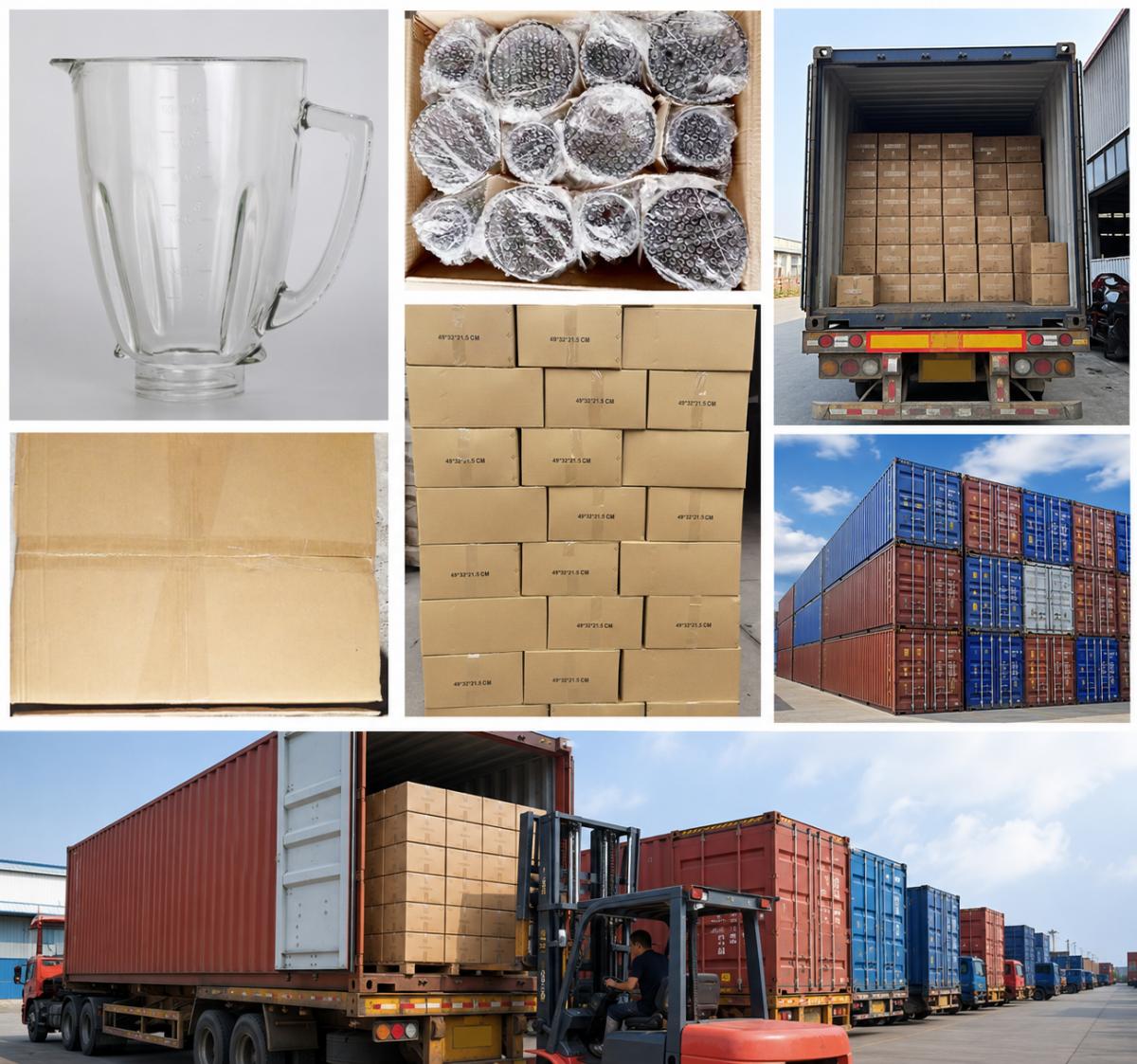
1. Define the Shipment Configuration and Costing Basis
Start by deciding where the calculation ends. In this guide, the destination is the importer’s warehouse, after delivery and unloading. Ongoing storage and onward distribution are tracked separately unless your costing policy includes them.
Next, list what the container will carry:
- A full container of the same glass blender jar model
- Several glass jar models, with quantities listed separately for each SKU
- Glass jars together with lids, blades, couplings, seals, or other replacement components
Some buyers place suitable smaller components inside the jars to use otherwise empty space. Those components may later be sold separately or with the jars as complete sets.
The packing arrangement and sales configuration are not necessarily the same. A blade assembly packed inside a jar does not automatically make the two items a sales set.
For jar-only orders, calculate cost per jar for each model. For mixed orders, keep SKU quantities and costs separate. If the products will be sold as complete sets, calculate the cost per agreed set.
2. Check What the Supplier’s Price Includes
Record the quotation currency, delivery term, named port or place, and included charges before entering costs.
Under FOB, the seller delivers the goods on board the vessel at the named shipment port and handles export formalities. FCA has a different delivery point and is often more appropriate when a container is handed to the carrier at a terminal.
For your worksheet, identify which origin costs are included and which remain payable by you. Check transport, export documentation, terminal handling, and loading charges so they are not counted twice.
When comparing FOB, FCA, or EXW quotations, first bring them onto the same cost basis. A lower quoted price may simply include fewer services.
3. Build Your 40HQ Cost Breakdown
Use a separate line for each charge. This makes the estimate easier to update as quotations become confirmed invoices.
| Cost item | What to enter |
|---|---|
| Product value | Unit price multiplied by quantity for each SKU |
| Additional origin charges | Buyer-paid costs not included elsewhere |
| Ocean freight and insurance | Current freight quotation and insurance premium |
| Import duty and levies | Broker-verified classification, customs value, and calculations |
| Import VAT/GST | Verified tax base and rate |
| Destination charges | Terminal, documentation, and handling costs |
| Customs clearance | Broker fees and applicable inspection expenses |
| Delivery and receiving | Port-to-warehouse transport, unloading, and handling |
| Other expenses | Bank fees, currency conversion, and other included costs |
Ask the forwarder which destination charges its quotation includes. Record quotation validity dates and use a consistent currency and exchange-rate assumption throughout.
The Basic Formula
Total landed cash outlay = Product value + Buyer-paid origin charges + Freight and insurance + Import duties and taxes + Destination and clearance charges + Delivery and receiving + Other included expenses
For a shipment containing one jar model:
Landed cash cost per jar = Total landed cash outlay ÷ Expected sellable jar quantity
For mixed shipments, allocate the relevant costs by SKU or complete set before calculating the unit cost.
4. Verify Customs Value and Tax Treatment
FOB value plus freight and insurance can be a useful planning subtotal, but it is not automatically the final customs value in every market.
Ask your customs broker to confirm classification, valuation adjustments, duty rates, VAT/GST calculations, other levies, and any applicable preferential treatment.
Do not automatically apply the classification of a complete blender to empty glass jars or separately supplied components. Packing accessories inside jars does not, by itself, determine how they should be declared.
Where relevant, keep two totals: the cash required to import the shipment and the economic landed cost after excluding taxes confirmed as recoverable. Your accountant should verify eligibility and recovery timing.
Need Product and Packing Data for Your Estimate?
Send Greafor your jar models, accessory quantities, destination port, and packaging requirements. We can discuss product pricing and packing information; your forwarder and customs broker should confirm freight, destination charges, duties, and taxes.
5. Calculate Cost Against Sellable Quantity
Loaded quantity and sellable quantity are not always identical. During planning, state any assumption for damage, shortages, or rejected units. After receiving the shipment, replace it with the actual accepted quantity.
The following jar-only example is illustrative, not a Greafor quotation or current freight offer.
| Item | Example amount |
|---|---|
| 10,000 jars at USD 3.00 | USD 30,000 |
| Ocean freight and insurance | USD 4,150 |
| Estimated duties and other levies | USD 2,000 |
| Import VAT/GST cash payment | USD 5,000 |
| Destination, clearance, delivery, and other expenses | USD 2,850 |
| Total cash outlay | USD 44,000 |
At 10,000 sellable jars, the cash cost is USD 4.40 per jar. If 100 jars are unsellable, the same outlay divided by 9,900 jars becomes approximately USD 4.44 per sellable jar.
If the full USD 5,000 tax payment is confirmed as recoverable, the economic cost would be USD 39,000, or USD 3.90 across 10,000 sellable jars. The upfront funding requirement remains relevant.
6. Use Jar Interior Space Where the Packing Configuration Allows
Buyers seeking to control shipping costs often discuss placing suitable small components inside the glass jars. Depending on dimensions and protection requirements, these may include lids, protected blade assemblies, couplings, or seals.
The benefit is not necessarily more jars per container. It may be the ability to ship additional accessories alongside the planned jar quantity with less separate external packaging.
Compare the proposed arrangement with separately packed accessories. Review:
- Jar and accessory quantities loaded
- Carton dimensions and total packed volume
- Gross weight and applicable loading limits
- Additional protective materials and packing labor
- Separate accessory cartons still required
- SKU identification and receiving instructions
Components must be secured and separated from the glass. Blade assemblies need appropriate protection; they should not be placed loosely inside jars.
Evaluate the actual product combination before confirming the loading plan. A space saving is worthwhile only if protection remains adequate and additional packing costs do not outweigh the logistics benefit.
7. Allocate Mixed-Container Costs by SKU or Set
For several jar models and accessories, start with each SKU’s purchase cost. Assign identifiable packaging, testing, and other direct expenses to the relevant product.
Allocate shared freight and handling using a consistent, documented method that reflects the shipment. Packed volume may be relevant to space-driven costs, while weight matters where payload is the constraint.
Accessories packed inside jars still have purchase costs and may contribute weight, protection, and handling requirements. Their landed cost is not zero. Equally, do not treat them as occupying separate full-size cartons if that is not how they are packed.
If products are sold separately, maintain costs for each jar and accessory SKU. If sold as complete sets, combine the relevant product costs and allocated expenses, then divide by sellable set quantity. Do not divide the entire shipment cost by the combined count of jars, lids, blades, and seals.
Greafor’s one-stop sourcing service for wholesale blender parts supports coordinated product discussions. Provide quantities and intended sales configurations so the quotation and packing plan can be reviewed together.
8. Compare Shipment Scenarios Before Ordering
Compare quotations using the same destination, specifications, tax assumptions, and cost boundary. Review cost per sellable SKU or set, total cash required, packing protection, quotation validity, and unconfirmed charges.
Test a second scenario with higher freight, an unfavorable exchange rate, or fewer accepted units. After delivery, replace estimates with invoices and receiving records. Those actual figures provide a stronger basis for replenishment decisions.
Request a 40HQ Quotation for Your Blender Jar Order
Browse our glass blender jars and replacement products, then send:
- Required jar models and quantity per model
- Accessory quantities and whether they will be sold separately or as sets
- Whether packing suitable accessories inside jars should be evaluated
- Destination country and port
- Packaging, private-label requirements, and shipment schedule
Build Your Cost Estimate Around a Defined Order
Share your product list with Greafor for product pricing, packing details, and an estimated loading configuration.
Request Your Wholesale Quotation Discuss Your Order on WhatsApp
This guide is for preliminary purchasing analysis. Verify freight, customs valuation, duties, tax treatment, and destination expenses with the relevant service providers and local advisers. Monetary examples are illustrative and are not product quotations, freight offers, or tax assessments.