

Glass Blender Jars vs Plastic Blender Jars for Wholesale Buyers: A Complete Sourcing Guide
Choosing between glass blender jars and plastic blender jars is not simply a material decision. For wholesale buyers, importers, distributors, and blender brands, jar material affects product positioning, unit cost, shipping weight, breakage exposure, packaging requirements, compatibility, and long-term replacement demand.
A glass blender jar may support a more premium or traditional product position, while a plastic blender jar can be more practical for lightweight, impact-resistant, and cost-sensitive appliance lines. Neither material is universally better. The right choice depends on your target market, retail position, shipping plan, product specification, and aftermarket parts strategy.
This B2B sourcing guide compares glass blender jars and plastic blender jars from a wholesale procurement perspective. It covers landed cost, MOQ, OEM development, compatibility, quality control, packaging, shipping risk, and replacement-parts planning to help buyers select the material that best fits their blender program.
1. Glass vs Plastic Blender Jars: Which Is Better for Wholesale Buyers?
Neither glass nor plastic blender jars are universally better. For blender importers, distributors, wholesalers, and private-label brands, the right choice depends on product positioning, durability requirements, shipping costs, target market, compatibility, and long-term replacement-parts strategy.
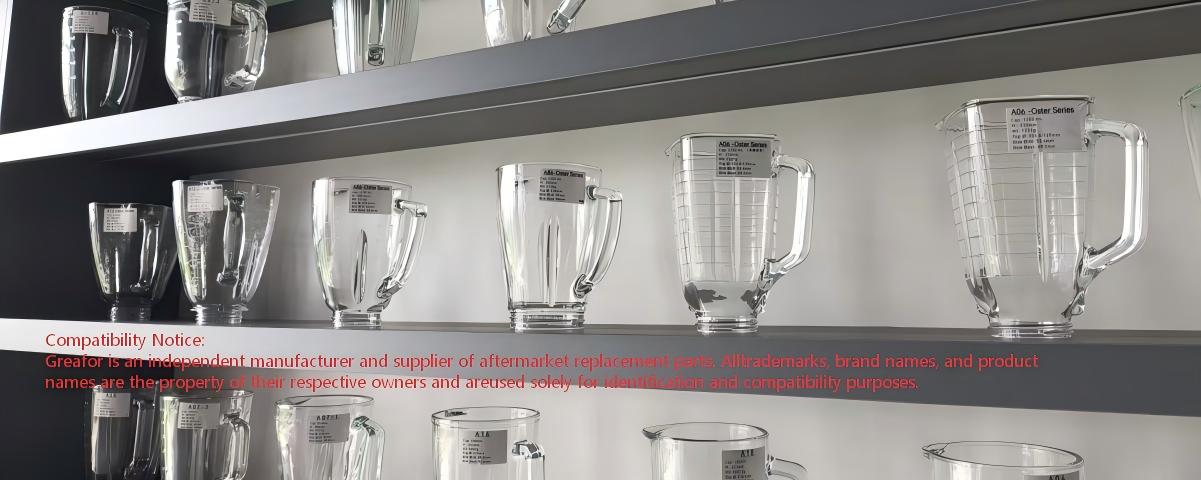
Glass blender jars are often a stronger fit for mid-range or premium household blender programs, established countertop models, and aftermarket supply where visual clarity, scratch resistance, and odor resistance matter. Plastic blender jars are often more practical for lightweight, compact, portable, or value-focused product lines where impact resistance, lower freight weight, flexible OEM molding, and lower initial cost are priorities.
For B2B sourcing, the decision should not be based on unit price alone. Buyers should compare the complete product program, including packaging, container loading, transit-damage exposure, blade and lid compatibility, MOQ, expected replacement demand, and total landed cost.
Quick Comparison: Glass vs Plastic Blender Jars
| Factor | Glass Blender Jars | Plastic Blender Jars |
|---|---|---|
| Premium appearance | Excellent | Good |
| Scratch resistance | Excellent | Material-dependent |
| Odor and stain resistance | Excellent | Material-dependent |
| Weight | Higher | Lower |
| Impact resistance | Lower | Higher |
| Shipping efficiency | Lower | Higher |
| OEM flexibility | Moderate | High |
| Initial cost | Usually higher | Usually lower |
| Replacement market | Strong for established glass-jar models | Model-dependent |
In short, choose glass when your blender program depends on premium positioning, long-term visual clarity, and replacement-jar demand. Choose plastic when lower weight, impact resistance, flexible product design, and shipping efficiency are more important.
2. Why Jar Material Matters in Wholesale Sourcing
In blender parts wholesale sourcing, jar material affects much more than the container itself. For importers, distributors, appliance brands, and private-label buyers, it can influence product positioning, packaging requirements, freight planning, quality control, replacement-parts availability, and the profitability of the overall blender program.
The decision made during product development can affect purchasing, inventory, warranty handling, and aftermarket supply long after the first container has shipped. The key question is not simply which material is better, but which material best supports the intended product range, target channel, and long-term supply model.
Product Positioning
Jar material contributes to product specification, price architecture, packaging standard, and intended market segment. It should be selected in line with the planned SKU, retail channel, expected margin, and brand positioning before bulk production begins.
Market Presentation
Material choice affects how the finished blender is presented across retail, e-commerce, and distribution channels. For appliance brands and distributors, the jar should support a consistent product image and the commercial position planned for the complete blender line.
Logistics and Landed Cost
Weight, packaging, handling requirements, and damage exposure all affect landed cost. Buyers should assess carton design, container loading, warehousing, domestic delivery, and claims allowance rather than comparing only ex-factory component prices.
Product Life and Quality Control
Material specification influences expected product life, appearance retention, inspection standards, and potential warranty exposure. Buyers should define material grade, wall thickness, dimensional tolerances, and performance expectations during sampling and pre-production approval.
Replacement Demand and Compatibility
For replacement blender jars, compatibility is essential. Capacity alone is not enough: the jar must match the original blade assembly, lid, jar base, seal, coupling, thread, and locking system. A clear replacement-parts plan helps distributors manage SKU selection, inventory, and after-sales supply.
Blender jar wholesale buyers who define these requirements before sampling are more likely to control landed cost, reduce avoidable claims, and build a repeatable supply program.
3. Glass vs Plastic Blender Jars: Key Differences Explained
Glass and plastic blender jars support different product strategies. The material should be selected according to target price, shipping model, OEM requirements, product life expectations, compatibility, and replacement-parts demand—not material preference alone.
Product Positioning and Price Range
Glass blender jars are commonly used in mid-range and premium countertop blender programs. Their clarity and substantial presentation can support a traditional household appliance position and a higher retail price. Plastic blender jars are often better suited to entry-level, compact, personal, and lightweight blender lines where cost control and portability are priorities.
Cost, Packaging, and Freight
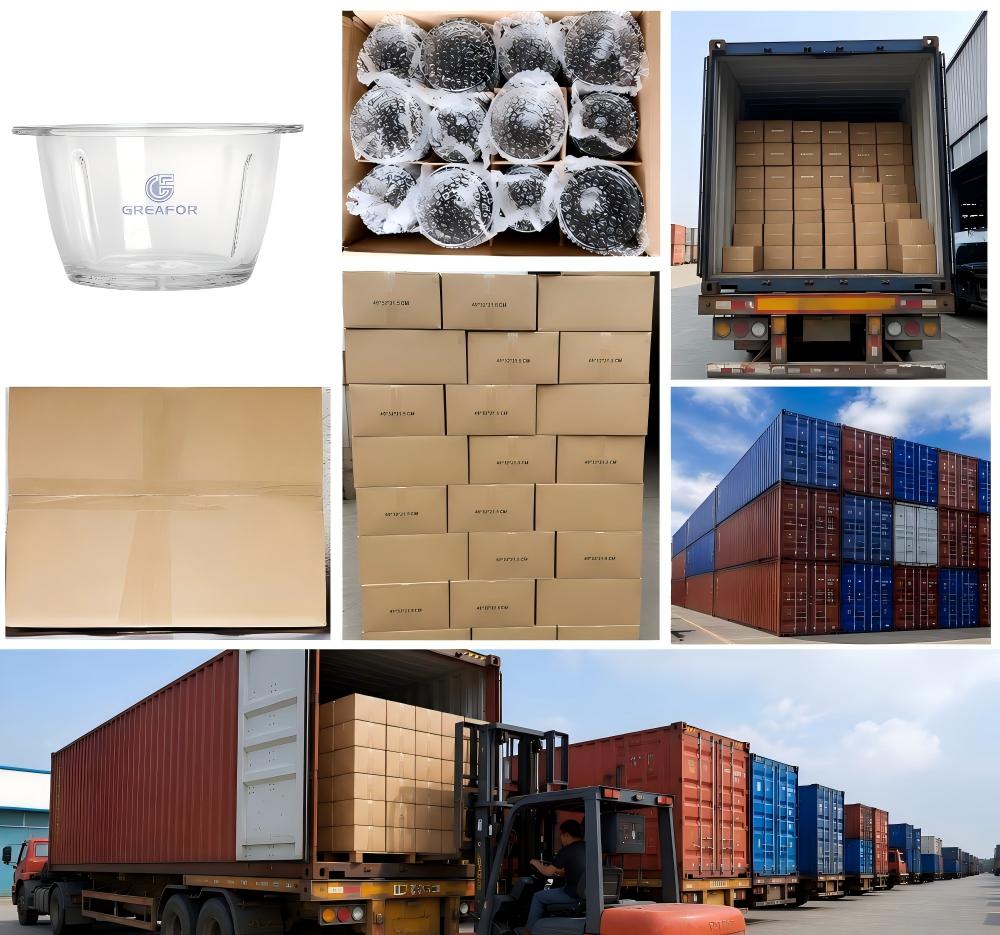
Glass often requires stronger inner protection, dividers, reinforced cartons, and careful container loading. Its higher weight can increase freight and handling cost. Plastic is generally lighter and more impact resistant, which may improve container efficiency and reduce transit-damage exposure.
Buyers should compare total landed cost, including jar price, blade and lid components, packaging, freight, breakage allowance, warehouse handling, and replacement stock. A glass-jar blender may justify additional logistics cost when it supports a stronger product position; in other cases, plastic may provide a more competitive cost structure.
Product Lifetime and Appearance
Glass blender jars generally maintain clearer surfaces and resist scratching, clouding, odors, and stains over time, helping distributors reduce appearance-related claims and keep replacement SKUs consistent. Plastic jars offer better impact resistance, but buyers should verify resin grade, wall thickness, molding quality, and expected service-life requirements before approving bulk production.
OEM Flexibility and Compatibility
Plastic usually offers more design flexibility for OEM and ODM projects. It can support custom shapes, integrated handles, color options, measuring features, and lightweight designs. Glass can also be customized, but it is more often selected for established countertop blender formats where capacity, thread design, bottom structure, and blade compatibility are the main requirements.
For replacement parts, compatibility comes first. The jar must match the original blade assembly, lid, jar base, seal, coupling, thread, and locking system. Switching between glass and plastic is not always possible without changing other components. Sample confirmation and assembly testing should take place before any bulk order.
Wholesale Decision
Glass is often selected for mid-range and premium blender programs, established glass-jar replacement SKUs, and product lines that require stable visual presentation over the planned service period. Plastic is often more suitable for lightweight, impact-resistant, compact, or cost-sensitive projects that need flexible OEM design options.
The right choice is the material that fits the intended SKU, target market, packaging plan, expected order volume, and replacement-parts strategy. Confirming samples and assembly compatibility before bulk production is the most reliable way to reduce sourcing risk.
4. Which Blender Jar Material Is Right for Your Wholesale Business?
The right blender jar material depends on the commercial model behind your order. Start with your target channel, retail position, expected order volume, shipping plan, and whether you are sourcing complete blenders, replacement jars, or a combination of both.
Choose Glass Blender Jars If You:
- Target mid-range or premium household blender markets.
- Supply replacement blender jars for established glass-jar models.
- Prioritize scratch resistance and stable long-term appearance.
- Want a traditional or higher-value product position.
- Need resistance to stains and retained odors in food-contact applications.
- Plan a replacement-parts catalog with repeat-order potential.
Choose Plastic Blender Jars If You:
- Prioritize lightweight products and lower shipping weight.
- Need higher impact resistance during distribution and handling.
- Target entry-level, price-sensitive, or high-volume markets.
- Need customized OEM shapes, integrated features, or color options.
- Want to improve container utilization and reduce transit-damage exposure.
- Are developing compact, portable, or personal blender product lines.
For Replacement Blender Jars, Compatibility Comes First
A 1.5L blender jar is not automatically compatible with every 1.5L blender. Two jars with the same stated capacity may still have different bottom structures, blade connections, lids, locking systems, or coupling requirements.
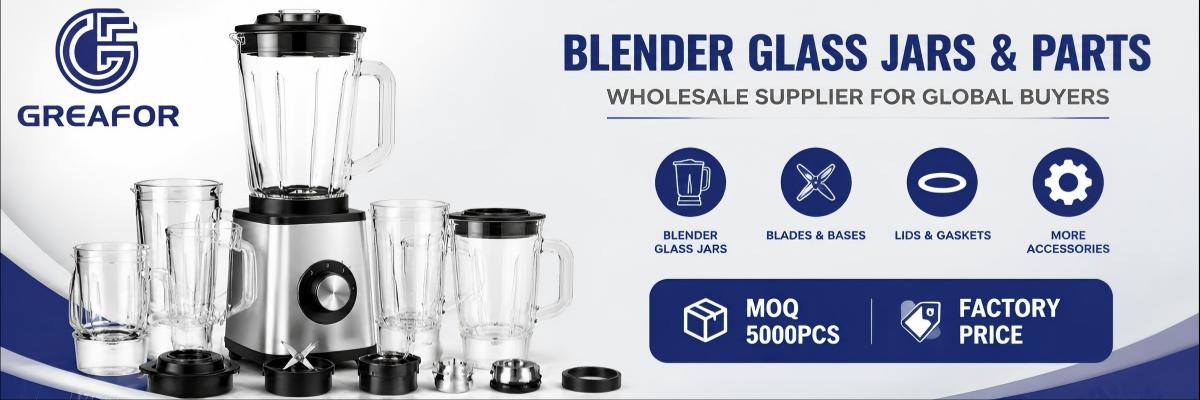
Before ordering compatible blender jars or other blender replacement parts, confirm overall dimensions, base diameter, bottom structure, blade assembly, shaft connection, blender coupling, lid, handle, locking design, sealing rings, and gaskets.
5. What Wholesale Buyers Should Calculate Before Ordering
Before placing a bulk order for glass blender jars or plastic blender jars, compare the complete sourcing cost and supply requirements—not only the quoted unit price.
- Unit cost: Jar price plus matching blades, lids, bases, seals, handles, couplings, and required accessories.
- MOQ and mixed models: Available quantities for standard items, OEM colors, private-label packaging, and combined container orders.
- Packaging and breakage allowance: Carton design, inner protection, dividers, loading method, and damage-control expectations.
- Freight and container utilization: Product weight, carton dimensions, units per carton, and container-loading efficiency.
- Sample and quality approval: Material specification, dimensions, threads, blade fit, lid fit, surface quality, and assembly performance before mass production.
- Replacement-parts plan: Jars, blades, lids, couplings, and seals needed for after-sales supply and repeat demand.
Total Landed Cost = Product Cost + Packaging + Freight + Breakage Allowance + Replacement Stock + Inventory Cost
6. How to Verify Replacement Blender Jar Compatibility
When sourcing compatible blender jars, capacity alone is not enough. A jar may look similar to another model but still fail to fit because the base diameter, thread, blade assembly, lid, seal, coupling, or locking system is different.
Before requesting a quotation, send clear product photos, measurements, model information, and, where possible, an original sample. Buyers building an aftermarket catalog can review our Compatible Blender Models and Brand Reference Guide to understand how jar, blade, lid, base, and coupling matching should be checked before a bulk order.
If you are also evaluating supplier capability, quality control, sample approval, OEM support, and MOQ, read our guide to choosing a reliable blender jar manufacturer in China .
Frequently Asked Questions
Are glass blender jars better than plastic blender jars for wholesale?
Neither material is always better. Glass is often selected for mid-range and premium blender programs, stable visual presentation, and established replacement-jar demand. Plastic is often selected for lightweight, impact-resistant, compact, or cost-sensitive product lines.
Can I order glass blender jars and plastic blender jars in one shipment?
Mixed orders may be possible depending on MOQ, model selection, packaging, production schedule, and container-loading requirements. Share your product list and estimated quantities so the supplier can review the most practical order plan.
What information is needed to source compatible replacement blender jars?
Provide jar photos, overall dimensions, capacity, base diameter, blade assembly details, coupling type, lid design, and, if possible, an original sample. The supplier should verify assembly matching before bulk production.
How do I reduce breakage risk when importing glass blender jars?
Confirm the packaging specification before production, including inner protection, carton strength, dividers, pallet or container-loading method, and any required drop-test or transport-test standard.
Can blender jars be customized for private-label projects?
Yes. Depending on the material and project requirements, OEM or ODM options may include jar capacity, shape, color, handle design, logo, packaging, and matching parts. MOQ and development requirements depend on the selected design.
Conclusion: Choosing the Right Blender Jar for Your Market
Glass and plastic blender jars serve different wholesale needs. Glass is often the stronger choice for mid-range and premium blender programs, long-term visual clarity, odor and stain resistance, and established glass-jar replacement demand. Plastic is often more efficient for lightweight, impact-resistant, compact, or cost-sensitive blender lines that require flexible OEM design and lower shipping weight.
For replacement blender jars, compatibility should always come before material preference. The correct jar must match the original blade assembly, lid, jar base, seal, coupling, and locking structure. For complete blender projects, choose the material that best supports your target market, planned retail price, packaging requirements, expected order volume, and long-term replacement-parts strategy.
Request a Blender Jar Sourcing Proposal
Looking for glass blender jars, plastic blender jars, compatible replacement blender jars, or a custom OEM blender jar project? Send Greafor your product photos, original sample, drawings, target quantity, destination market, and packaging requirements.
Our team can help evaluate jar material, blade and lid compatibility, coupling and base matching, MOQ, packaging options, quality requirements, and the most practical supply plan for your wholesale blender program.