

Related Projects
How Professional Importers Source Compatible Blender Replacement Parts from China: A Complete B2B Guide
As global demand for appliance repair and aftermarket solutions continues to grow, compatible blender replacement parts have become an increasingly important product category for wholesalers, distributors, appliance repair businesses, and brand owners.
Many buyers searching for blender replacement parts manufacturers in China quickly discover that sourcing compatible blender jars, blades, lids, couplings, and other accessories involves far more than comparing prices. Compatibility verification, OEM capabilities, quality control systems, and long-term supply stability all play critical roles in a successful sourcing project.
This guide explains how professional importers source compatible blender replacement parts from China and what factors should be evaluated before selecting a manufacturing partner.
Why Compatible Blender Replacement Parts Are a Growing Global Business
The aftermarket appliance industry has experienced steady growth over the past decade. Instead of replacing an entire blender when a component fails, consumers increasingly choose to replace only the damaged part.
Several market trends are driving this demand:
The Growth of the Repair Economy
Consumers are becoming more cost-conscious and environmentally aware. Replacing a blender jar or blade assembly is often significantly cheaper than purchasing a new appliance.
Sustainability and Waste Reduction
Many countries are promoting repairability and product lifespan extension. This creates ongoing demand for replacement components.
Expansion of Appliance Service Networks
Repair centers, maintenance businesses, and regional distributors require stable supplies of replacement parts to support their customers.
E-commerce and Aftermarket Sales Growth
Online marketplaces have made it easier for consumers to find compatible replacement components, increasing demand for wholesale suppliers.
For importers, compatible blender replacement parts represent a stable and scalable business opportunity with long-term market demand.
What Blender Replacement Parts Do Professional Buyers Purchase Most Frequently?
Although product demand varies by market, the following components are typically among the highest-volume replacement parts.
| Product Type | Common Replacement Reason |
|---|---|
| Blender Glass Jar | Breakage, wear, accidental damage |
| Blade Assembly | Reduced cutting performance |
| Blender Lid | Daily wear and tear |
| Coupling | Mechanical wear |
| Seal Ring / Gasket | Leakage prevention |
| Jar Base Components | Structural replacement |
Among these products, blender glass jars and blade assemblies generally account for the highest replacement frequency.
Professional distributors often prefer suppliers capable of providing multiple compatible components from a single source to simplify purchasing and inventory management.
Step 1: Verify Compatibility Before Comparing Prices
One of the most common sourcing mistakes is evaluating suppliers based solely on price before confirming compatibility.
Professional importers typically follow a structured verification process:
Identify the Blender Model
Start by collecting accurate model numbers and technical specifications.
Different models may appear similar while using completely different:
-
Thread systems.
-
Blade assemblies.
-
Jar dimensions.
-
Lid structures.
-
Coupling designs.
Confirm Critical Dimensions
Key measurements include:
-
Jar height.
-
Jar diameter.
-
Thread type.
-
Blade shaft dimensions.
-
Coupling size.
Verify Thread Compatibility
Thread mismatch remains one of the most common causes of compatibility issues.
Before ordering replacement jars, buyers should verify thread design carefully.
Conduct Sample Testing
Experienced importers always request samples before placing bulk orders.
Sample testing helps verify:
-
Physical fit.
-
Operational performance.
-
Leakage resistance.
-
Durability.
Only after successful testing should mass production begin.
Step 2: Why OEM Capability Matters More Than Factory Size
Many buyers focus on factory size when selecting suppliers. However, OEM development capability is often more important than production scale.
A supplier with strong OEM experience can provide:
Custom Logo Solutions
Private-label branding remains an important requirement for distributors and wholesalers.
Customized Packaging
Retail-ready packaging improves product value and market competitiveness.
New Product Development
Some importers require modifications based on local market requirements.
Drawing and Sample-Based Production
Professional manufacturers should be capable of developing products from:
-
Technical drawings.
-
Existing samples.
-
Customer specifications.
OEM flexibility often determines whether a supplier can support long-term business growth.
Step 3: Understanding MOQ Beyond the Numbers
Minimum Order Quantity (MOQ) is one of the most misunderstood aspects of sourcing from China.
Many buyers focus only on finding the lowest MOQ, but MOQ is influenced by several production realities.
Manufacturing Efficiency
Production equipment performs most efficiently at specific output volumes.
Packaging Requirements
Custom packaging often requires minimum production runs.
Tooling Investment
New molds and custom components require cost recovery through production volume.
Quality Control Costs
Inspection procedures become more cost-effective when spread across larger quantities.
Instead of asking only, “What is your MOQ?”, professional buyers also ask, “What MOQ provides the best balance between pricing, customization, and production efficiency?”
This approach often leads to better long-term sourcing decisions.
Step 4: Evaluate the Manufacturer, Not Just the Product
Selecting the right supplier requires a comprehensive evaluation process.
Manufacturing Experience
How long has the supplier been producing blender components?
Product Range
Can they provide:
-
Glass jars.
-
Blades.
-
Lids.
-
Couplings.
-
Gaskets.
from one source?
OEM & ODM Capability
Can they support customized projects?
Export Experience
Have they supplied wholesalers and distributors in international markets?
Quality Control System
Do they conduct inspections during:
-
Raw material sourcing.
-
Production.
-
Assembly.
-
Packaging.
Production Capacity
Can they support long-term growth and repeat orders?
Communication Efficiency
Fast and accurate communication is often a strong indicator of future project success.
Common Mistakes New Importers Make
Many sourcing problems can be avoided by understanding common industry mistakes.
Mistake #1: Choosing Based Only on Price
The lowest quotation often results in higher long-term costs through quality issues and compatibility problems.
Mistake #2: Ignoring Compatibility Verification
Even small dimensional differences can create significant product failures.
Mistake #3: Skipping Sample Evaluation
Bulk production should never begin without approved samples.
Mistake #4: Purchasing Components from Multiple Factories
Managing several suppliers increases complexity and creates quality consistency challenges.
Mistake #5: Focusing on Immediate Costs Instead of Long-Term Supply Stability
Reliable manufacturing partnerships often provide greater value than short-term savings.
Why More Importers Prefer One-Stop Blender Parts Suppliers
As sourcing becomes more competitive, many distributors prefer working with manufacturers that offer complete compatible replacement solutions.
Benefits include:
-
Simplified procurement.
-
Consistent product quality.
-
Easier inventory management.
-
Faster communication.
-
Reduced logistics complexity.
A one-stop supplier may provide:
-
Blender Glass Jars.
-
Blade Assemblies.
-
Blender Lids.
-
Couplings.
-
Seal Rings.
-
Related Accessories.
This approach reduces operational costs and improves purchasing efficiency.
Frequently Asked Questions
Can Compatible Blender Parts Fit Original Machines?
Compatible parts are typically designed to fit specific blender models. Compatibility should always be verified through samples and technical specifications.
How Can I Identify the Correct Blender Model?
Model numbers are usually found on the appliance base or product label.
What Is the Most Frequently Replaced Blender Component?
Glass jars, blade assemblies, lids, and couplings are among the most commonly replaced components.
Should I Request Samples Before Ordering?
Yes. Sample evaluation is considered a standard practice for professional buyers.
Can One Manufacturer Supply Multiple Compatible Components?
Many experienced manufacturers offer complete replacement solutions covering jars, blades, lids, and related accessories.
How Important Is OEM Capability?
OEM capability is critical for distributors seeking private-label products, custom packaging, or market-specific product development.
Conclusion
Successful sourcing of compatible blender replacement parts from China involves much more than finding the lowest price.
Professional importers focus on compatibility verification, OEM development capability, manufacturing experience, quality control systems, and long-term supply stability.
By following a structured sourcing process and partnering with experienced manufacturers, distributors and wholesalers can reduce risks, improve product consistency, and build a sustainable aftermarket parts business.
For companies seeking reliable sourcing solutions, evaluating the supplier as a long-term manufacturing partner is often the most important decision of all.
About Greafor
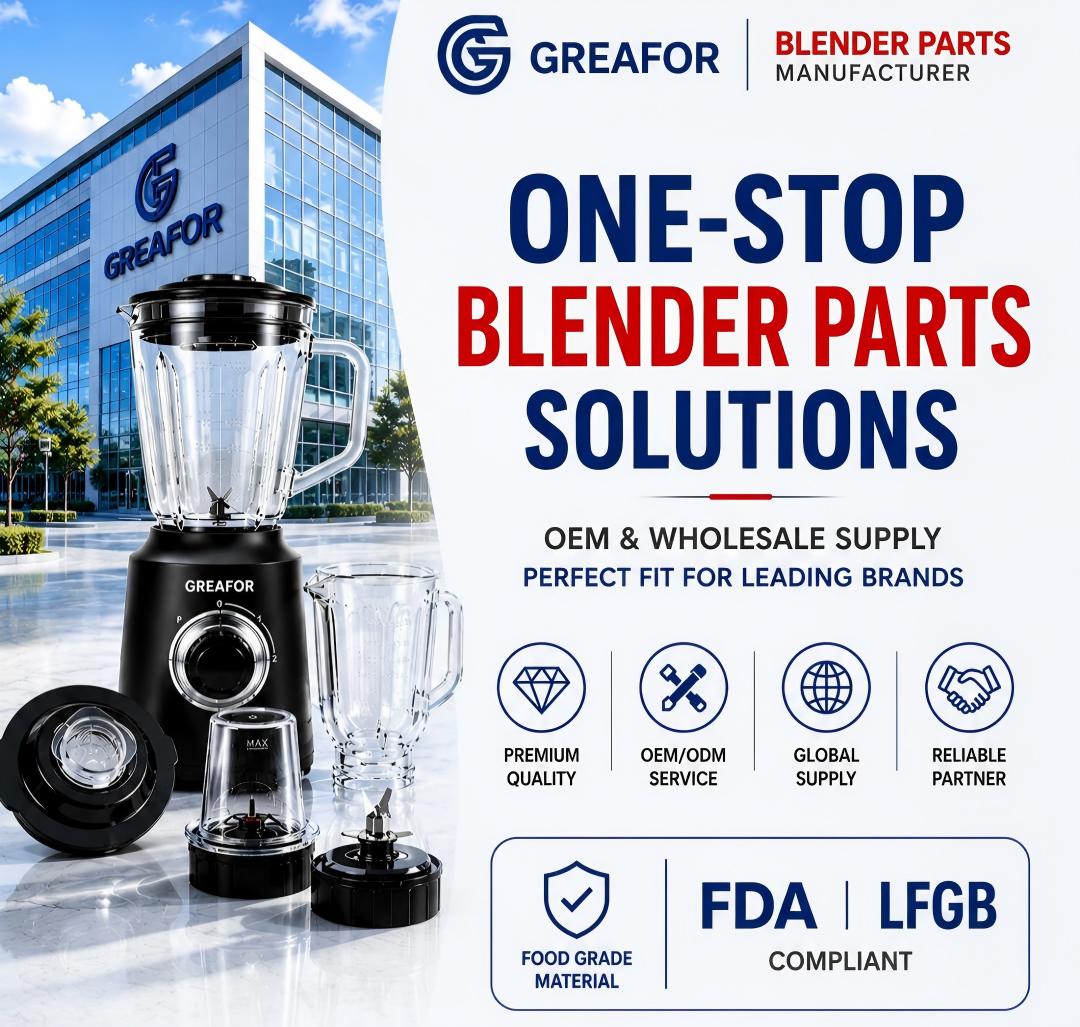
Greafor is a brand of Foshan Huijing Glass Products Co., Ltd., a China-based manufacturer specializing in blender glass jars, blender spare parts, compatible replacement solutions, and OEM/ODM development for wholesalers, distributors, importers, and brand owners worldwide.
Explore More Compatible Blender Replacement Solutions
Related Resources
- Compatible Blender Replacement Parts
- How to Match Blender Jar Thread Types
- Compatible Blender Jars vs Replacement Blender Jars
- Blender Blade Assembly Compatibility Guide
- How to Identify Compatible Blender Models for Wholesale Projects
Looking for a reliable supplier of compatible blender replacement parts from China?
Contact us today to request a catalog, sample, and factory-direct quote.
Get Compatibility Assistance via WhatsApp
Trademark Disclaimer: Greafor is an independent manufacturer and supplier of aftermarket replacement parts. All trademarks, brand names, and product names are the property of their respective owners and are used solely for identification and compatibility purposes.