

Related Projects
How to Manage Sample Approvals for Multi-Model Blender Parts Orders and Reduce Delays
Three glass jar models are ready for review. One blade assembly needs a revision. The retail box artwork is still with the buyer's marketing team.
Should the entire order wait?
Not necessarily. But moving ahead without clear approval boundaries can create a different problem: production starts against an incomplete or outdated specification.
For importers, wholesalers, and appliance brands, the goal is to keep independent work moving while holding any item that still depends on an unresolved decision.
The practical rule is simple: track approval by SKU, sample version, and component configuration—not as one “approved” or “pending” status for the entire order.
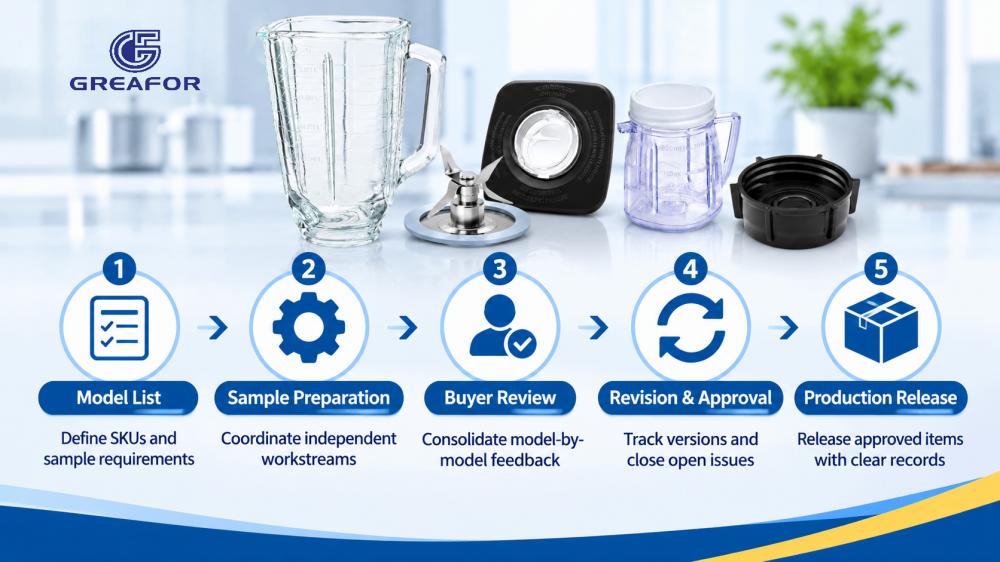
1. Start with an Approval Map, Not Just a Sample List
A list tells the supplier which samples to prepare. An approval map also shows what each sample represents, who must review it, and what depends on the result.
Before preparation begins, separate the project into four types of work:
- Existing models: Confirm the selected product reference and any order-specific requirements.
- Matching configurations: Review the jar with the blades, lid, seals, or other components required for that application.
- Custom development: Identify the drawings, modifications, and revisions that need technical approval.
- Packaging and branding: Track artwork, labels, physical structure, and packing instructions separately.
A single SKU may involve more than one workstream. For example, the jar body may be accepted while the matching lid and printed box remain under review.
Keep that distinction visible. “Jar approved” should not become shorthand for “everything connected to this item is approved.”
2. Use One Master Record for Every Model and Revision
The approval record does not need to be complicated. A shared spreadsheet can work if both teams use the same current version.
Include the customer item code, supplier reference, sample revision, review owner, dependency, next action, and agreed response date.
| Item and version | Approval scope | Current status | Next action |
|---|---|---|---|
| Jar A — V1 | Jar body only | Approved within stated scope | Complete the associated assembly review |
| Assembly A — V2 | Jar, blade housing, blades, and seal | Buyer review | Return consolidated test feedback |
| Jar B — V1 | Specified jar configuration | Revision required | Confirm the requested change and issue V2 |
| Box A — Artwork V3 | Graphics and text only | Under review | Confirm artwork; structural approval remains separate |
The entries above are illustrative, not records of a customer project.
Label physical samples with the same references used in the record. Photographs and feedback should identify those references too, so an older sample cannot be mistaken for the current production proposal.
3. Review Independent Items in Parallel—Keep Dependencies Together
Parallel review does not mean shipping every sample separately or beginning production early. It means avoiding a sequence where one unrelated approval prevents another review from starting.
For example, an existing jar sample can be reviewed while a customized model is being revised. Packaging text can be checked while the physical insert is under development.
Other decisions remain connected. A blade assembly that depends on a revised jar interface cannot receive final configuration approval against the superseded jar.
| Task | What may proceed | What still needs confirmation |
|---|---|---|
| Independent jar models | Separate sample reviews | Each model's own approval requirements |
| Jar and matching blade assembly | Individual characteristic checks | The intended assembled configuration |
| Packaging artwork | Review of sufficiently defined graphics and information | Final content after any product or set changes |
| Packaging structure | Initial design and evaluation | Confirmed product dimensions, contents, and protection requirements |
If several models share a component, record that relationship. A change to one common lid, gasket, or housing may require more than one approval to be reopened.
For the technical checks behind a matching configuration, see our blender spare parts compatibility guide.
Preparing Samples for Several Models?
Send Greafor your model list, required components, quantities, and customization details. Identify which references are established and which still need evaluation so we can discuss the sample scope and dependencies.
Request a Multi-Model Project Review Discuss Your Model List on WhatsApp
4. Make Feedback Specific Enough to Act On
“Please improve the fit” can lead to another round of questions. Useful feedback identifies the item, sample version, observed issue, review conditions, and requested outcome.
For a revision, record:
- What was reviewed and against which requirement
- What needs to change, supported by photos or measurements where relevant
- Whether another component or packaging item may be affected
- Whether a revised physical sample, drawing, or other evidence is required
- Who will confirm that the action is closed
Discussions can take place through email, WhatsApp, or a meeting. The final instruction should still be consolidated into the master record and acknowledged by both sides.
Agree on the review window before samples arrive. Name one person to consolidate comments from purchasing, technical, and branding teams, while identifying who has authority to approve each scope.
Use Approval Statuses Carefully
A practical set of statuses is: under review, approved within stated scope, revision required, or pending information.
If “approved with conditions” is used, specify exactly what it authorizes. Acceptance of the jar's appearance subject to a revised lid does not automatically authorize production of the full set.
Any condition affecting fit, function, safety, or the final specification should remain visible until formally resolved.
5. Separate Sample Approval from Production Release
An approved sample is an important input to production. It is not the only one.
Before release, the relevant item also needs confirmed quantities, component allocation, packaging instructions, inspection requirements, and the other agreed order conditions.
Preliminary capacity discussions may take place earlier. Buyers and suppliers can review possible scheduling or material requirements while approvals are underway, but should distinguish those discussions from authorization to incur costs or begin manufacturing.
For an approved model group to move ahead, confirm:
- The exact items, quantities, and revisions being released
- Required approvals and any expressly excluded work
- Authorized written release and applicable order conditions
- Whether shared components, tooling, or production minimums affect the arrangement
- The consequences for storage, packing, and shipment consolidation
Producing an approved item earlier does not necessarily mean shipping it earlier. A consolidated shipment may still wait for the remaining models. Discuss that trade-off before agreeing on staged production.
For the broader handover into bulk supply, read From Approved Sample to Bulk Order: How Greafor Coordinates Blender Glass Jar Production.
6. Review Open Decisions, Not Just Elapsed Time
A schedule becomes more useful when each open item has a named owner, next action, and agreed response date.
During project reviews, focus on three questions:
- Which decision is currently preventing the next necessary step?
- What can proceed without depending on that decision?
- Has a revision changed any previously approved item?
Keep the original and revised schedule visible. If a specification changes or feedback arrives later than planned, review the effect on sample preparation, production, and shipping rather than assuming the original dates remain achievable.
This keeps attention on actions that can resolve the delay without pressuring either party to approve an incomplete configuration.
Coordinate Your Multi-Model Blender Parts Order with Greafor
Greafor supplies blender glass jars and related replacement components for wholesale and OEM projects. A multi-model inquiry may include jars, blade assemblies, lids, seals, couplings, and private-label packaging, with different review requirements for each.
Our one-stop sourcing service for wholesale blender parts provides a starting point for discussing those items within one purchasing project.
To begin, send:
- Model references, photos, drawings, or available sample information
- Estimated quantity per SKU
- Required components and intended set configurations
- Existing approvals and details still needing review
- Customization and packaging requirements
- Destination market and target milestones
You do not need a finished approval system to make an inquiry. A clear model list and an honest record of unresolved requirements are enough to start a more useful discussion.
Start with One Clear Product List
Share your multi-model requirements with Greafor to discuss sample arrangements, component dependencies, revision needs, and order-specific production planning.
This article describes a recommended coordination approach, not a guaranteed approval or production schedule. Sample availability, charges, preparation time, revisions, MOQ, production release, and shipment arrangements must be confirmed for the specific project. Staged production is subject to technical dependencies, written authorization, and the supplier's confirmed production arrangements.