

CBU vs SKD vs CKD for Blenders: How Import Duties and Local Assembly Affect Your Costs
A blender importer should compare CBU, SKD, and CKD based on total ready-to-sell cost, not packaging format alone. The right model depends on import duties, HS classification, local assembly cost, annual volume, labor availability, quality control capability, and long-term market strategy.
For blender importers, distributors, and appliance brands, choosing between CBU, SKD, and CKD is not simply a question of how products are packed or shipped. In many markets, the decision is closely tied to import duties, local assembly costs, manufacturing incentives, local content requirements, and long-term market positioning.
A complete blender imported as a CBU may be simple to sell, but the finished product can face a higher import duty than components or kits in markets where CKD or SKD assembly is encouraged. For a distributor with sufficient volume and local assembly capability, importing blender components and completing assembly locally can potentially improve the total cost structure while supporting local production.
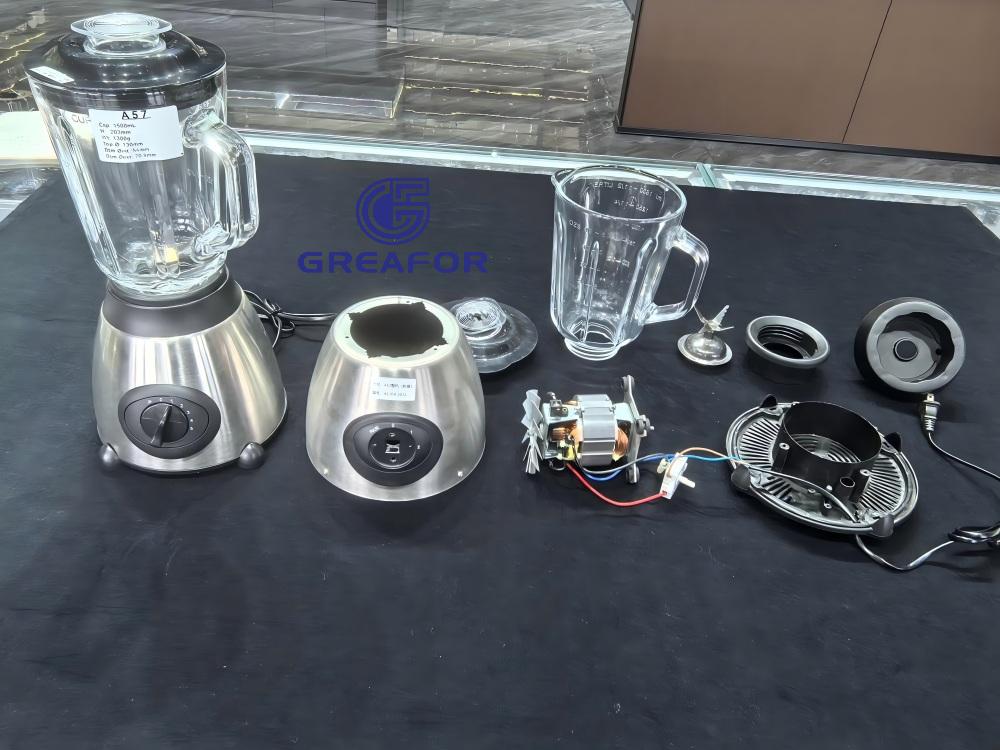
What Do CBU, SKD, and CKD Mean for Blenders?
Before comparing commercial advantages, it helps to understand what each model actually means.
CBU — Completely Built Unit
CBU means the blender is fully assembled and tested before shipment. The buyer imports the finished blender and normally only needs to handle import clearance, warehousing, distribution, sales, and after-sales service.
CBU is usually the simplest option for companies that do not have local assembly facilities. It can be suitable for new market entry, smaller distributors, market testing, buyers without assembly capability, and customers who prioritize fast delivery to the sales channel.
The main limitation is that the buyer imports the complete finished product. Depending on the destination country's tariff structure, a finished blender may face a higher import duty than certain CKD or SKD configurations.
SKD — Semi Knocked Down
SKD means the blender is shipped in partially assembled modules or components, with some assembly completed in the destination market. The exact SKD configuration can vary according to the buyer's requirements—some components may be supplied as preassembled modules while other operations are completed locally.
SKD can be attractive for distributors that want to reduce finished-product assembly, start local assembly without building a full CKD operation, improve shipping efficiency, explore potential tariff advantages, increase local value addition, and gradually develop assembly capability. SKD is often the middle ground between CBU and CKD.
CKD — Completely Knocked Down
CKD means the blender is supplied as separate components or parts that are assembled in the destination market. Depending on the project, the CKD package may include motor and electrical components, blender jar, blade assembly, lid, base components, switches or control components, seals and other accessories, packaging materials, and assembly hardware.
The exact bill of materials and assembly level should be defined before production. CKD requires more local capability than CBU or SKD, including assembly space, trained workers, quality control, component inventory management, assembly procedures, product testing, and packaging operations. But for the right market and volume, CKD can become a local manufacturing strategy, not just a different shipping format.
How Import Duties and Local Assembly Change Blender Costs
The biggest reason some blender importers choose CKD over CBU is often not freight cost. It is the difference between importing a finished product and importing components for local assembly.
In some countries, finished household appliances can face relatively high import duties, while specific parts or CKD/SKD kits may receive different tariff treatment. For example, World Bank research on household appliance assembly in North Africa notes that customs duties and taxes can be significantly lower for CKD imports than for SKD imports in certain markets, and that CKD assembly has expanded in connection with tax benefits and local integration requirements ([World Bank](https://documents1.worldbank.org/curated/en/754361472471984998/txt/105360-REVISED-PUBLIC-MENA-Digital-Print-English-sep-2016.txt)).
This means the commercial question for an importer is often: should we continue importing complete blenders, or should we import components and complete part of the production locally? The answer depends heavily on the destination market.
The Tariff Gap Can Change the Business Case
Consider a simplified, illustrative example. Suppose a market has the following hypothetical tariff structure:
| Supply Model | Example Import Duty | vs. CKD |
|---|---|---|
| CBU finished blender | 30% | 6x higher |
| SKD kit | 15% | 3x higher |
| CKD kit | 5% | Baseline |
The above numbers are illustrative only. Actual duties vary by country, HS classification, product configuration, and local regulations.
In this example, a CBU finished blender faces a duty rate 6 times higher than a CKD kit. At a customs value of $100 per unit, that is $30 vs. $5—a $25 difference per blender before considering local assembly costs. At 100,000 units per year, the theoretical gap becomes $2.5 million.
Of course, CKD also adds local assembly, labor, equipment, and QC costs. The real question is whether the duty savings can offset those local costs at your volume. But the scale of the tariff gap is what makes the comparison worth doing in the first place.
This is why large appliance importers do not always compare suppliers only by FOB price. They compare the complete landed and ready-to-sell cost.
CKD Is Also About Local Manufacturing
Import duty is only one part of the CKD business case. Many governments encourage local assembly because it can support employment, technical skills, manufacturing capability, local supplier development, technology transfer, and industrial development.
With CBU, most of the manufacturing value is created before the product reaches the destination market. With CKD, part of the manufacturing value is created inside the destination market—the buyer becomes a local assembler, not just an importer.
Local Assembly Creates a Different Cost Structure
A common mistake is to assume that CKD automatically means lower cost. It does not. The buyer must add local costs such as assembly labor, factory or workshop costs, equipment, testing, quality control, inventory management, training, packaging, local transportation, production losses, and working capital.
The correct question is not "Is CKD cheaper than CBU?" but rather: "At what annual volume does local assembly become economically better than importing the finished blender?" That is the CKD break-even point. For a small importer selling only a few thousand units per year, CBU may remain the better option. For a high-volume distributor or appliance brand, the calculation can be very different.
CBU vs SKD vs CKD: Quick Comparison
| Factor | CBU | SKD | CKD |
|---|---|---|---|
| Product condition | Fully assembled | Partially assembled | Fully knocked down |
| Local assembly | None/minimal | Moderate | Extensive |
| Technical requirement | Low | Medium | High |
| Initial investment | Low | Medium | Higher |
| Speed to market | Fastest | Fast | Slower |
| Local manufacturing value | Low | Medium | High |
| Potential tariff advantage | Limited in some markets | Possible | Potentially stronger in some markets |
| Quality control complexity | Lower | Medium | Higher |
| Best suited for | New/smaller importers | Growing distributors | High-volume/local assembly programs |
The tariff treatment shown above is a general business framework, not a universal tariff rule. Importers should confirm the actual HS classification, duty rate, CKD/SKD definition, and local incentives with the destination country's customs authority or customs broker.
What Is Your Total Ready-to-Sell Cost?
FOB price alone does not tell you whether CBU, SKD, or CKD is the better option. For a serious blender import project, compare the complete cost structure:
CBU: Factory Price + Freight + Import Duty + Local Logistics + Warehousing + Distribution
SKD: Kit Price + Freight + Import Duty + Local Assembly + Labor + Testing + Packaging + Local Logistics
CKD: Component Cost + Freight + Import Duty + Assembly + Labor + Equipment + Testing + Packaging + Inventory Management + Local Logistics
The best model is the one that produces the most competitive ready-to-sell cost while meeting the buyer's operational and regulatory requirements.
Comparing CBU, SKD, or CKD for your market? Send your destination country, expected annual volume, blender specification, current import model, local assembly capability, and private-label requirements. Greafor can review which supply structure may fit your project.
When Does Each Model Make Sense?
Choose CBU When:
- You are entering a new market
- Annual volume is relatively small
- You do not have local assembly capability
- Speed to market is the priority
- You want the simplest operation
Choose SKD When:
- CBU import costs are becoming a problem
- You want to introduce local assembly gradually
- You have some assembly capability
- You want a middle ground between CBU and CKD
- You are scaling your market
Choose CKD When:
- CBU import duties significantly affect your margins
- Your market provides favorable treatment for CKD components
- You have sufficient annual volume
- Local labor and assembly infrastructure are available
- Local manufacturing or localization is part of your strategy
- You want greater control over production and future expansion
Many appliance companies progress through stages: CBU for market entry and demand testing, then SKD for local assembly and cost optimization, and eventually CKD for higher local integration and larger-scale production. This staged approach can reduce the risk of investing heavily in local manufacturing before market demand has been proven.
What to Check Before Choosing CKD
Before asking a Chinese blender manufacturer for a CKD quotation, buyers should evaluate at least seven points:
1. What Is the CBU Import Duty?
Start with the actual tariff applicable to the finished blender. Do not rely on a general internet percentage. Check the correct HS classification and current local customs rules.
2. Is There a Different Tariff for CKD or SKD?
Some markets distinguish between finished products, semi-knocked-down kits, completely knocked-down kits, and individual parts. The exact definition matters—a product that is called "CKD" commercially may not automatically qualify for a CKD tariff category.
3. Is Local Assembly Required to Receive an Incentive?
Some markets have specific requirements related to assembly operations, local investment, local employment, local content, production volume, and factory registration. These must be confirmed before the project starts.
4. What Annual Volume Can You Realistically Achieve?
A CKD project needs enough volume to justify assembly equipment, workers, training, QC systems, inventory, and management. Higher volume generally makes the fixed cost per unit easier to absorb.
5. What Assembly Capability Do You Already Have?
A buyer with an existing appliance assembly line has a very different cost structure from a distributor starting from zero.
6. What Components Should Be Localized?
The long-term goal does not always have to be 100% local production. A buyer may initially import most components from China and later source selected items locally:
- Phase 1: Imported CKD components + local assembly
- Phase 2: Imported core components + local packaging
- Phase 3: Imported key components + selected local parts
- Phase 4: Higher local content and broader local manufacturing
7. Can the Chinese Manufacturer Support Your Assembly System?
This is often overlooked. A successful CKD program requires more than sending loose parts. The supplier should provide clear BOM, component identification, assembly instructions, packaging specifications, QC standards, testing requirements, spare parts information, production traceability, and a sample approval process.
CKD Component Management and Quality Control
When importing CBU blenders, the buyer receives a finished product. With CKD, the buyer receives a production system in parts. That changes the quality-control requirements.
For example, the buyer needs to ensure that the correct blender jar matches the correct base, the blade assembly matches the jar, seals and lids are correct, electrical components match the specification, motors meet the required performance, components are correctly identified, assembly instructions are clear, and finished units are tested before packing.
For high-volume programs, even a small component mismatch can create significant production losses. This is why CKD projects should be managed as an OEM manufacturing program, not simply as a spare-parts order.
CBU, SKD, and CKD Can All Support Private Label Blenders
The choice of assembly model does not prevent a buyer from developing a private-label brand. A brand owner can choose:
- CBU Private Label: The manufacturer produces and packs complete blenders under the buyer's brand. Best for companies prioritizing speed and simplicity.
- SKD Private Label: The buyer imports partially assembled units and completes selected operations locally. This provides more local involvement while keeping assembly complexity manageable.
- CKD Private Label: The buyer imports components and completes the production process locally. This provides the highest level of local manufacturing and customization.
For long-term appliance brands, CKD can become part of a broader strategy involving OEM product development, local assembly, private labeling, local distribution, and aftermarket support. If you are also evaluating private-label options, read our guide to building a private label blender accessories program.
How Greafor Supports CBU, SKD, and CKD Blender Projects
Greafor works with importers, distributors, and appliance brands that need different levels of product supply and local assembly. Our product capabilities include complete blender units, blender glass jars, blender spare parts, compatible replacement components, meat chopper glass bowls and parts, and complete meat chopper units, as well as OEM and private-label production.
For SKD and CKD projects, the supply structure can be discussed according to the buyer's local assembly requirements. This may include component BOM development, product specification confirmation, assembly-level definition, component matching, packaging configuration, QC requirements, sample approval, bulk production, spare parts planning, and private-label packaging.
The exact CKD or SKD configuration should be defined according to the destination market, customs requirements, and the buyer's assembly process.
Frequently Asked Questions
What is CBU in blender imports?
CBU means Completely Built Unit. The blender is fully assembled and tested before shipment and is imported as a finished product.
What is SKD for blenders?
SKD means Semi Knocked Down. The blender is shipped in partially assembled modules or components, with part of the assembly completed in the destination market.
What is CKD for blenders?
CKD means Completely Knocked Down. The blender is shipped as separate components for complete assembly in the destination market.
Is CKD always cheaper than CBU?
No. CKD can have a lower import duty in some markets, but local assembly, labor, equipment, QC, packaging, and inventory costs must also be included. The correct comparison is total ready-to-sell cost, not duty alone.
Does CKD always have a lower import duty?
No. Tariff treatment varies by country, HS classification, product configuration, and local regulations. Buyers should confirm the actual duty and CKD/SKD requirements with the local customs authority or customs broker.
When should a blender importer consider SKD?
SKD can make sense when CBU import costs are becoming a problem, the buyer wants to introduce local assembly gradually, or the buyer has some assembly capability but is not ready for full CKD. SKD is often a practical transition between CBU and CKD.
What should I prepare for a CKD quotation?
Prepare the destination country, expected annual volume, blender specifications, current CBU or CKD/SKD model, local assembly capability, and private-label requirements. Existing product photos, drawings, or samples can help the manufacturer evaluate the project more efficiently.
Can Greafor supply CBU, SKD, and CKD blender projects?
Yes. Greafor can discuss component supply, product specifications, packaging, and assembly requirements for CBU, SKD, and CKD blender projects according to the buyer's market and production needs.
Related Articles
- How to Choose a Reliable Blender Parts Manufacturer in China—Foundation guide covering supplier evaluation, factory verification, and sourcing strategy.
- Blender Spare Parts Manufacturer: 10 Questions to Ask Before Ordering—Practical checklist for evaluating compatibility, OEM support, quality, and repeat-order supply.
- How to Build a Private Label Blender Accessories Program—Step-by-step guide for brand owners and distributors developing private-label accessory ranges.
- OEM vs Compatible Replacement Blender Parts: Which Is Better for Distributors?—Commercial decision framework comparing OEM, private-label, and compatible product strategies.
- How South American Distributors Build a Reliable Blender Spare Parts Supply Chain from China—Market-specific supply chain guide with real B2B sourcing scenarios.
Start Your Blender CBU / SKD / CKD Project With Greafor
Send us your destination country, expected annual volume, blender specifications, current import model, local assembly capability, and private-label requirements. Our team can discuss the appropriate product configuration and prepare a supply solution based on your market and production requirements.
Destination Country + Annual Volume + Blender Specs + Current Import Model + Assembly Capability + Private-Label Needs